Description
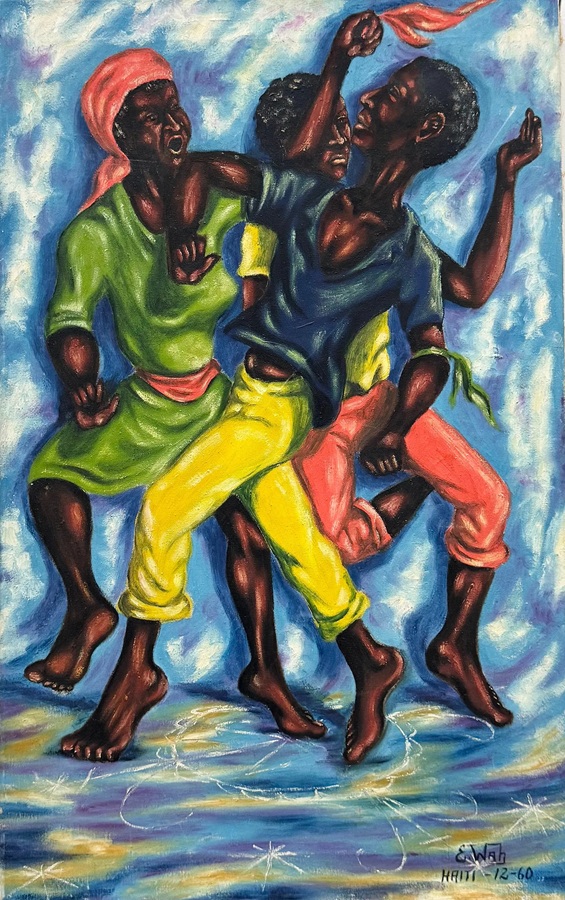
An exceptional original oil on canvas by Haitian modernist painter Edouard Wah (1938–2003), signed lower right and dated December 1960.
This dynamic composition captures three dancing figures in powerful rhythmic motion against a vibrant blue atmospheric background. The exaggerated anatomy, dramatic gestures, and vivid chromatic contrasts reflect the artist’s modernist sensibility and expressive approach to figurative painting during an important early period of Haitian modern art.
Unlike traditional pastoral or marketplace scenes commonly associated with Haitian painting, this work demonstrates a more emotionally charged and expressionist visual language, giving the piece remarkable movement and contemporary presence.
Executed in oil on canvas, the painting remains highly impactful both as a collectible work of Caribbean modernism and as a statement interior piece.
Artwork Details
- Artist: Edouard Wah (Haitian, 1938–2003)
- Title: Dancers (unofficial title)
- Date: 1960
- Medium: Oil on canvas
- Signature: Lower right
- Dimensions: 30 x 19 inches
- Condition: Very good vintage condition consistent with age
Early Life and Education
Wah’s artistic journey began at a tender age when he attended Petit Seminaire College St. Martial, receiving his first formal instruction in perspective and anatomy. His father recognized his potential and enlisted the guidance of one of Haiti’s renowned art teachers, a decision that would lay the foundation for his future artistic pursuits. This early exposure to the fundamentals of art ignited a spark within him, setting him on a lifelong path of creative exploration.
As a young artist, Wah initially explored ceramics from 1951 to 1953. However, he later decided to explore the world of dance and, from 1957 to 1959, ventured into engraving with Industries Nationales Réunies. It was in 1959 that he made a pivotal choice to dedicate himself entirely to painting, a decision that would shape the course of his career.
Artistic Evolution
Throughout his artistic journey, Edouard King Fong Wah displayed a remarkable ability to adapt and evolve. He ventured beyond his initial “naif” style, which is characteristic of Haitian art, and experimented with classical era painting. Over time, he mastered these styles but ultimately settled for a modern eclectic style that defined him as an artist. What’s remarkable is that this style, which he identified with, was introduced to him in the latter part of his artistic career, showcasing his flexibility and versatility as an artist.
Wah’s artistic pursuits were not limited to painting alone. He delved into acting, using it as a side venture to complement his artistic career, showcasing his multifaceted talents.
Cultural Contributions
In 1963, Wah founded the cultural center “Calfou” in Port-au-Prince, a space dedicated to promoting Haitian culture, especially the arts and music. This endeavor demonstrated his commitment to preserving and sharing the rich cultural heritage of Haiti. Simultaneously, he and his brother were entrusted by the Haitian government to restore murals in the bicentennial section of the city, contributing significantly to the preservation of the nation’s historical and cultural legacy.
Emigration and Legacy
In 1971, amid the tumultuous era of the Duvalier regime, Edouard King Fong Wah emigrated to the United States, where he settled in Philadelphia for the next thirteen years. Although he was physically distant from his beloved Haiti, his heart remained firmly connected to his homeland. Wah continued to create art that bore the essence of his Haitian roots while embracing the influences of his new surroundings.
Tragically, on September 27, 2003, during one of his visits to Haiti, Edouard King Fong Wah passed away. He left behind a legacy of artistic brilliance, cultural preservation, and a dedication to transcending boundaries through his work. He is survived by his two daughters and two sons.
Edouard King Fong Wah’s life and artistic journey serve as a testament to the power of art to transcend cultural barriers, celebrate diversity, and preserve the essence of a nation’s heritage. His ability to evolve and adapt his artistic style while remaining rooted in his Haitian identity is a source of inspiration for artists and art enthusiasts around the world, ensuring that his legacy continues to thrive.
Reviews
There are no reviews yet.