Description
Stivenson Magloire was one of the most compelling and intense figures of late twentieth-century Haitian painting. Born on August 16, 1963, in the Port-au-Prince area, he emerged from a deeply artistic lineage yet forged a visual language entirely his own—one marked by raw energy, spiritual symbolism, and emotional urgency.
Magloire was the son of the renowned Haitian painter Louisiane Saint-Fleurant, a central figure associated with the Saint-Soleil movement. Growing up in an environment where art was a daily, living practice, he began painting at a very young age. Though often described as self-taught, his development was shaped by close proximity to some of Haiti’s most influential artists, including Jean-Claude “Tiga” Garoute. From the outset, Magloire resisted imitation. Rather than following the softer, lyrical tendencies often associated with Saint-Soleil, he pushed toward a more confrontational and expressionistic approach.
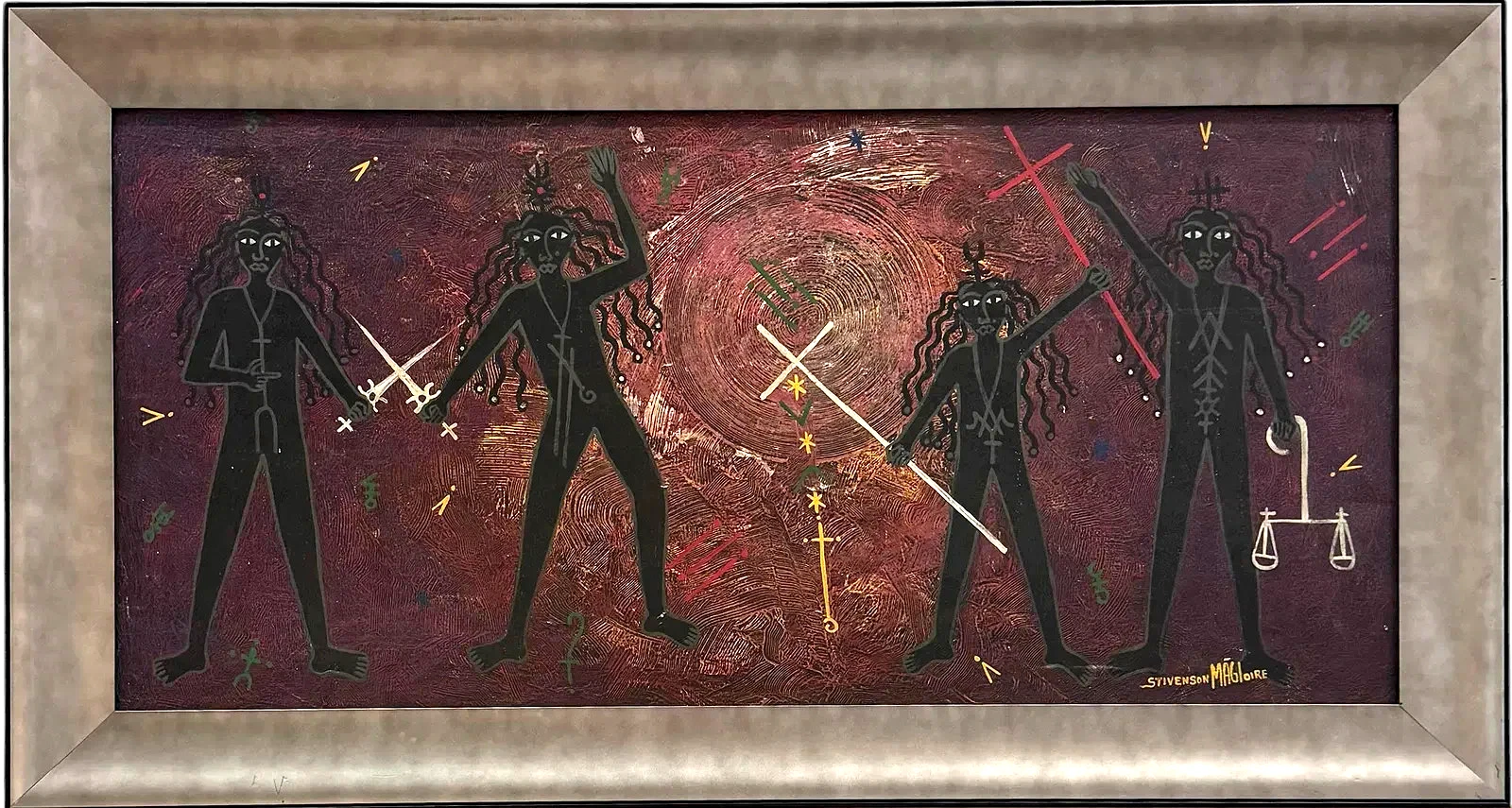
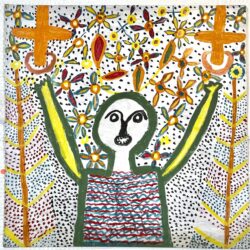
Collectors and critics frequently describe Magloire’s work as “violent”—not in a literal sense, but in its intensity. His paintings are charged with tension, populated by distorted figures, birds, and symbolic forms that seem to vibrate with inner force. Drawing deeply from Vodou cosmology while also incorporating Christian imagery, his compositions reflect the layered spiritual reality of Haiti, where the visible and invisible worlds coexist. These elements are not decorative; they are structural, giving his work a sense of urgency and psychological depth.
Magloire’s art speaks to struggle, vision, and revelation. His figures often appear compressed within the picture plane, their gestures exaggerated, their expressions haunting. Color is used boldly and instinctively, reinforcing the emotional weight of each scene. Through this visual language, Magloire addressed themes of spirituality, social pressure, and human vulnerability with remarkable maturity for an artist so young.
Despite his short life, Magloire achieved significant international recognition. His work was exhibited in Japan, Canada, the United States, and France, including participation in a major exhibition at the Grand Palais in Paris in 1989. He was also featured in the French magazine Elle, which highlighted both his paintings and his distinctive artistic voice. Today, his works are held in private and public collections worldwide, including prominent galleries and museums in the United States.
Tragically, Stivenson Magloire’s life was cut short when he was killed on October 9, 1994, at just thirty-one years old. His death sent shockwaves through Haiti’s artistic community and marked the loss of one of its most powerful emerging voices.
Today, Magloire’s paintings stand as enduring testaments to his vision—works of profound spiritual intensity and expressive force. They continue to resonate with collectors and scholars alike, securing his place among the most important Haitian artists of his generation.
Reviews
There are no reviews yet.